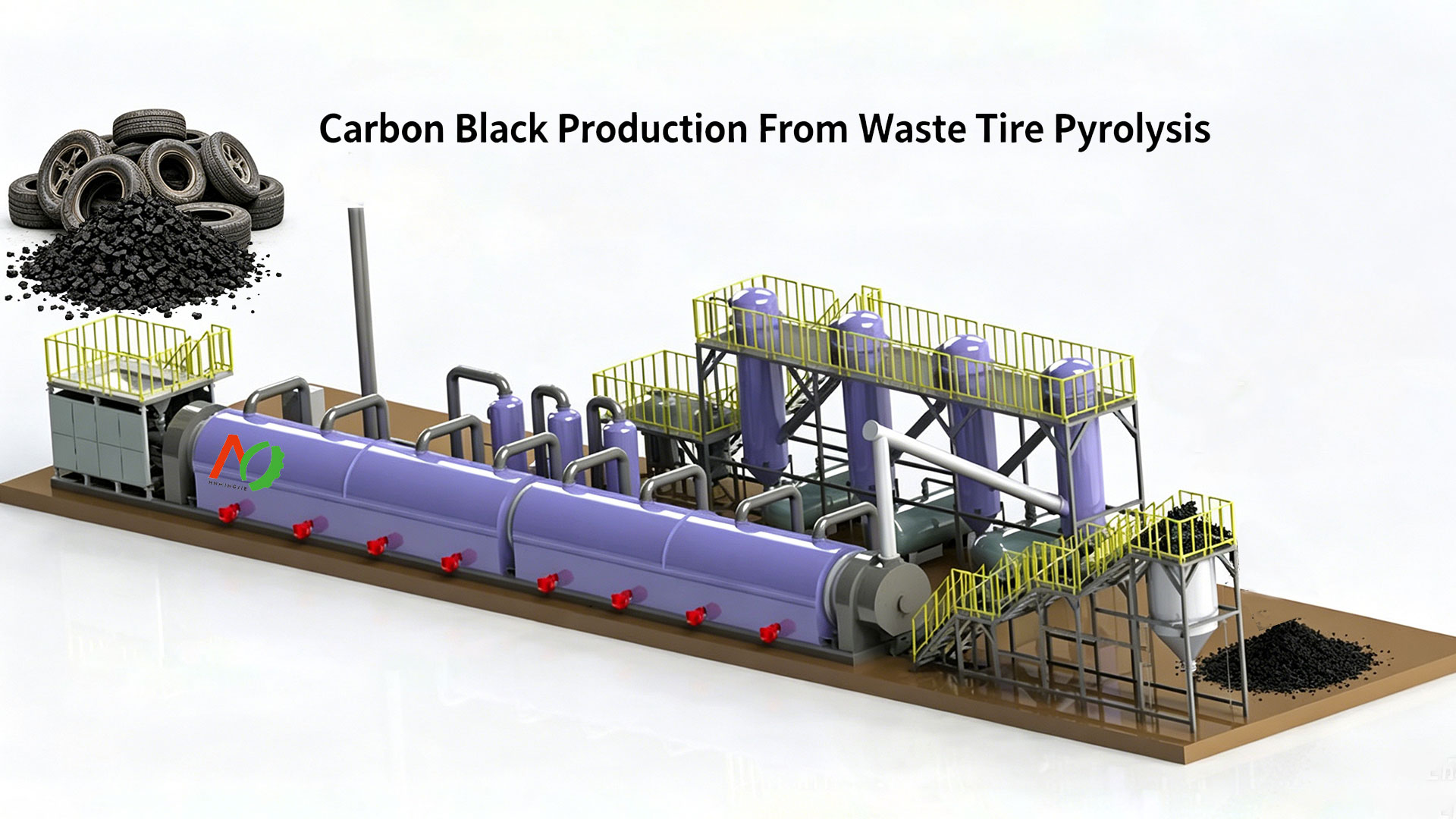
Waste tires contain approximately 30% reinforcing carbon black, a key filler that provides wear resistance and anti-aging properties. Pyrolysis equipment enables the carbon black production from these tires, while also yielding pyrolysis oil, steel wire, and combustible syngas.
The tyre pyrolysis plant thermally decomposes waste tires in an oxygen-free, sealed environment to produce raw pyrolysis carbon black. This material is then subjected to purification, modification, and granulation to yield recovered carbon black.
During the pyrolysis process, waste tires are converted into three product phases: pyrolysis oil, pyrolysis gas, and solid carbon black. Solid carbon black accounts for approximately 30%–35% of the output.
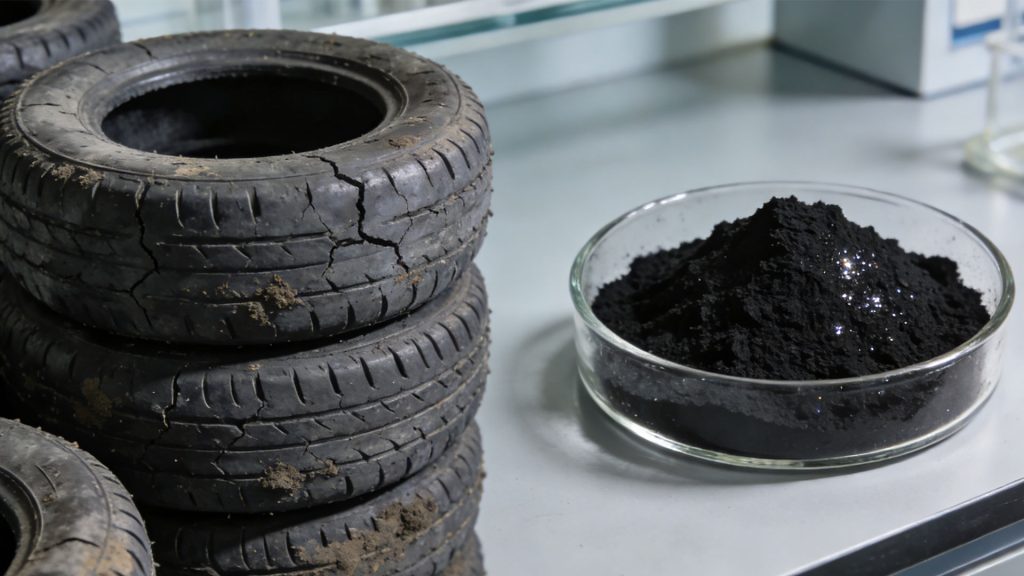
However, the crude carbon black obtained directly from pyrolysis is of low quality, characterized by high ash content, poor activity, and large particle size. Consequently, it must undergo systematic deep processing to be upgraded into recoverable carbon black.
The following section outlines the carbon black production process from waste tires, covering the entire value chain from pretreatment, pyrolysis to deep processing.
Carbon Black Production Process
Waste Tire Pre-treatment
Waste tires are cut into 5–10 cm rubber granules using a shredder. Simultaneously, the majority of the steel wire is removed via magnetic separation. The size of the shredded rubber pieces directly affects the efficiency of the subsequent pyrolysis process. Smaller granules ensure more uniform heating and a more complete pyrolysis reaction.
Sealed Feeding
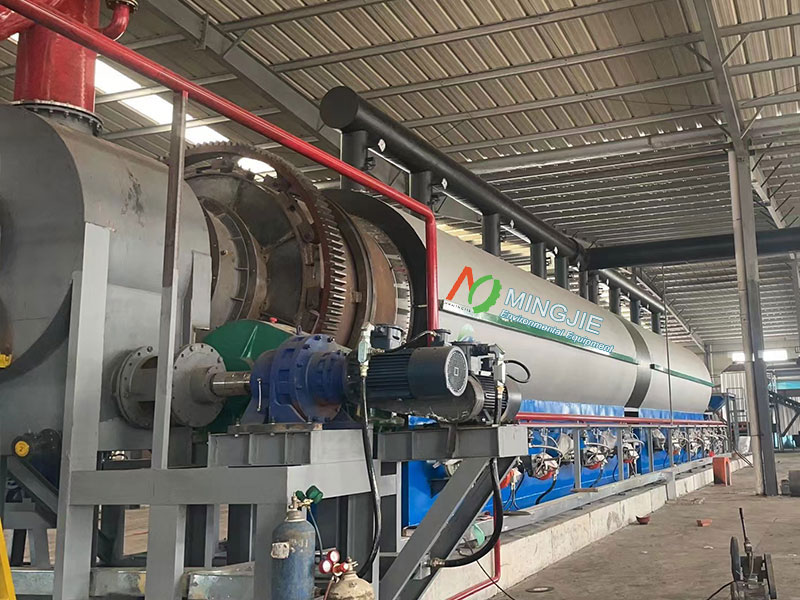
The rubber granules are fed into the tyre pyrolysis plant via a sealed screw feeder. The entire conveying process operates under negative pressure within a sealed system, preventing dust leakage and protecting the carbon black feedstock from premature oxidation or degradation.
Tire Pyrolysis
The rubber granules enter the fully continuous pyrolysis plant, where they are heated to 500–600°C in the absence of air, causing the long-chain rubber polymers to break down. The oil and gas components form high-temperature pyrolysis vapors, which enter a condensation system for oil recovery. The solid residue—a mixture of carbon black and steel wire—is continuously discharged from the rear of the reactor. Combustible syngas generated during pyrolysis is recovered and burned to provide heat for the reactor, achieving energy self-sufficiency.
The exhaust gas generated during the waste tires pyrolysis undergoes a multi-stage purification system to ensure emissions meet regulatory standards.
Separation and Purification of Crude Carbon Black
The mixture of carbon black and steel wire discharged from the furnace bottom enters high-intensity magnetic separation equipment, where high-purity tire steel wire is completely separated. The resulting crude carbon black contains trace amounts of rubber ash and inorganic fillers. It undergoes multi-stage vibrating screening and air-swept dedusting to remove large-particle impurities, yielding a primary crude carbon black powder.

Refined Modification of Recovered Carbon Black
The crude carbon black is fed into an ultrafine pulverizer to reduce particle size, thereby enhancing tinting strength and reinforcing properties. It is then introduced into an activation reactor and subjected to high-temperature activation using trace amounts of water vapor or carbon dioxide. This process opens the carbon black’s closed pores, improving adsorption performance. Simultaneously, desulfurization and de-ashing occur, reducing sulfur and ash content to meet raw material standards for the rubber industry.
Carbon Black Granulation
The modified ultrafine carbon black powder is prone to dusting and high transport losses. Wet or dry granulation processes are employed to produce high-strength carbon black granules, facilitating packaging and transportation.
Summary
The recovered carbon black production from waste tires via pyrolysis establishes a circular pathway transforming waste rubber into high-end carbon materials. This approach not only addresses the challenge of managing “black pollution” caused by waste tires but also reduces the extraction of fossil-based raw materials and lowers industrial carbon emissions.
In terms of environmental benefits, pyrolyzing one ton of waste tires reduces carbon dioxide emissions by approximately 1.1 tons. Based on an annual processing capacity of 100,000 tons, this translates to an annual reduction of over 110,000 tons of CO2 emissions. With continuous upgrades to pyrolysis equipment and ongoing breakthroughs in deep-processing technologies for carbon black, the industry for producing carbon black from waste tires is poised for significant growth.