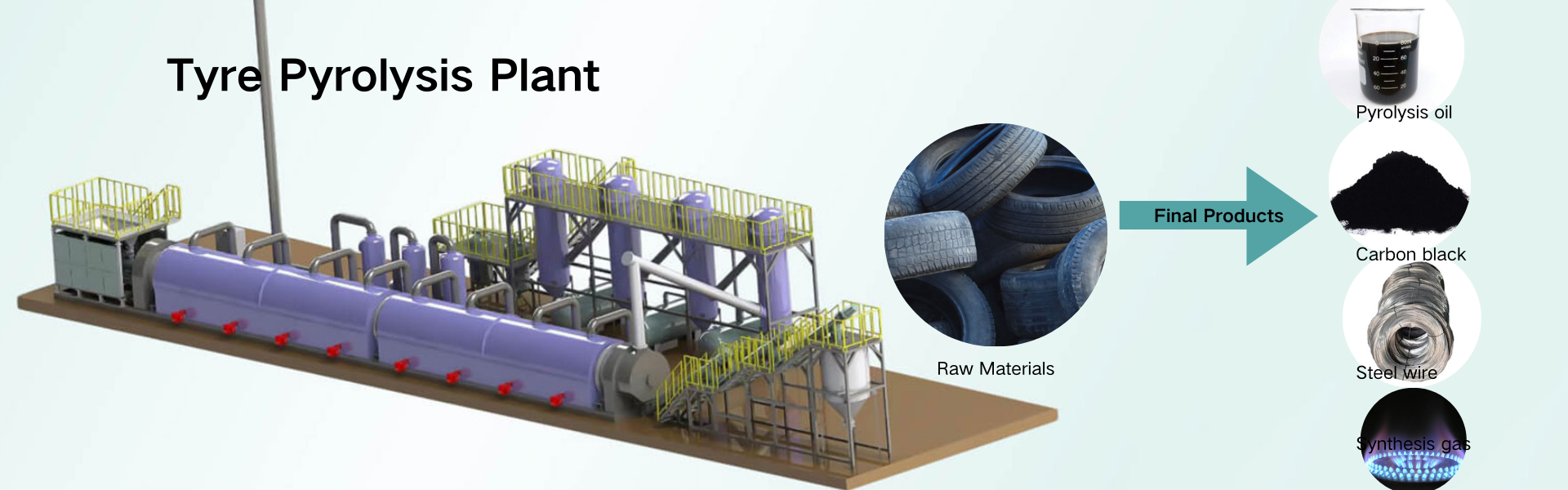
Tyre pyrolysis plant can convert waste tires into pyrolysis oil, carbon black, steel wire, and syngas. The pyrolysis process does not use oxygen, which makes exhaust emission control simpler and more economical.
Waste Tyre Pyrolysis Recycling Plant
The pyrolysis plant heats waste tires rubber to 300-450℃ in an oxygen-free environment, causing the long-chain polymers to break down and crack.
The macromolecular organic matter vaporizes to form oil and gas. This oil and gas is cooled and condensed into pyrolysis fuel oil. The combustible syngas that cannot be condensed is recovered. The solid residue produces carbon black and tire steel wire.
The entire waste tyre pyrolysis process involves no combustion of raw materials and no direct burning of materials with open flames, achieving resource recovery from solid waste.
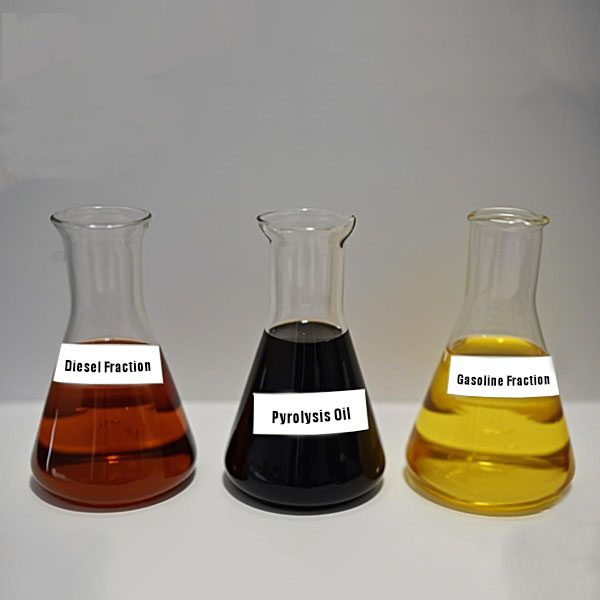
Tyre pyrolysis oil (TPO) is a liquid product obtained by condensation and recovery after pyrolysis. It is a typical waste-derived fuel and resource recovery product.
Pyrolysis carbon black is the solid carbonaceous residue collected after the waste tyre pyrolysis. It is a sustainable raw material recovered from waste tires.
Steel Wire (15%)
Waste tires contain a large amount of steel wire, which can be recycled through pyrolysis to reduce resource waste.
Syngas (10%)
These combustible gases mainly include methane, ethylene and propylene, which can be used for internal heating recycling.
Contact Us To Get Tyre Recycling Pyrolysis Solution As a professional pyrolysis plant manufacturer, Mingjie Group can provide effective solutions to reduce environmental pollution and recover resources.
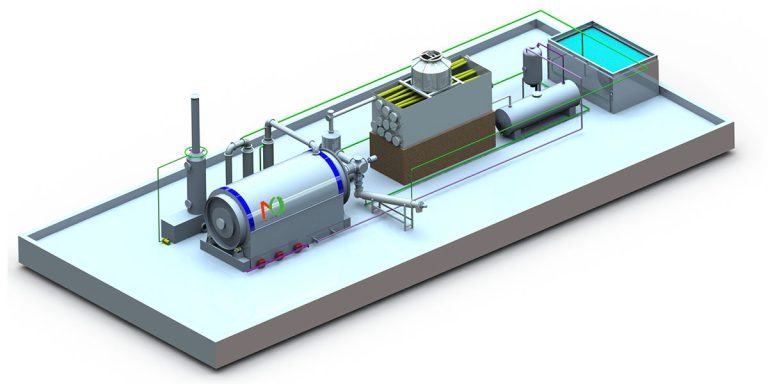
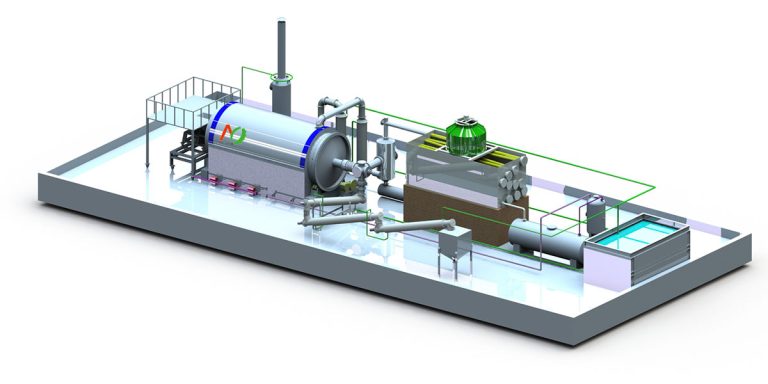
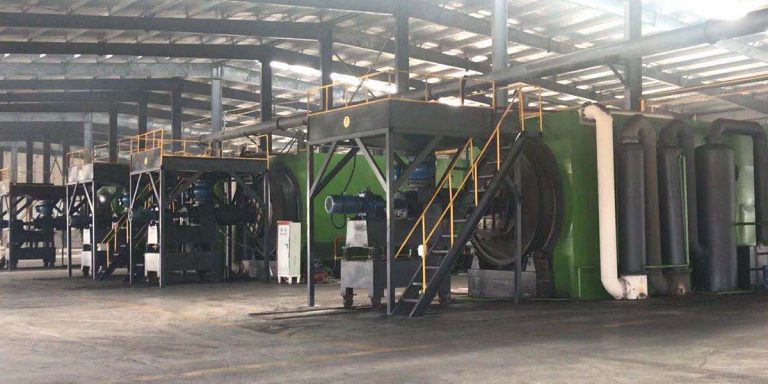
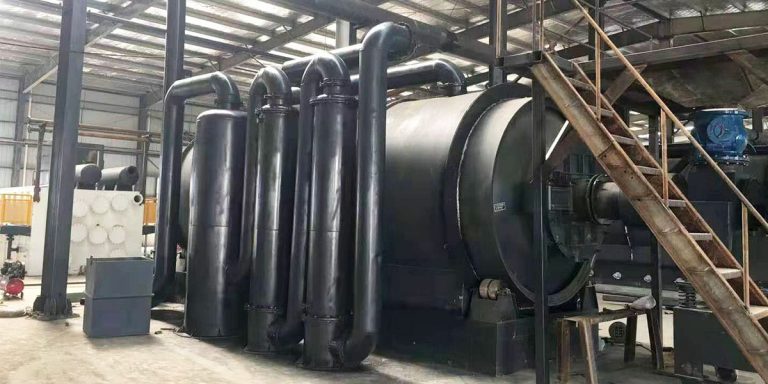
The waste tyre pyrolysis plant for sale is not a single pyrolysis reactor. It comprises feeding system, pyrolysis system, condensation system, discharge system, flue gas purification system, and control system. These systems work together to achieve efficient tyre pyrolysis. The pyrolysis reactor is the key piece of equipment in the tyre pyrolysis plant. Mingjie pyrolysis plants can be divided into three types according to different processes: Skid-mountedSmall Pyrolysis Plant,Batch Pyrolysis Plant, Semi-continuous Pyrolysis Plant and Fully Automatic Tyre Pyrolysis Plant.
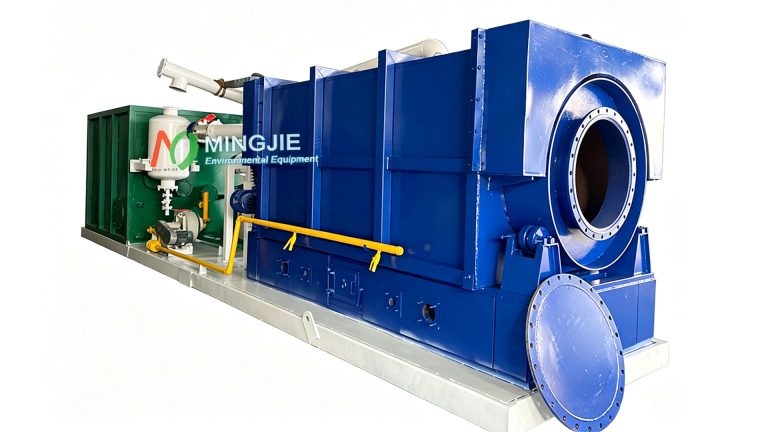
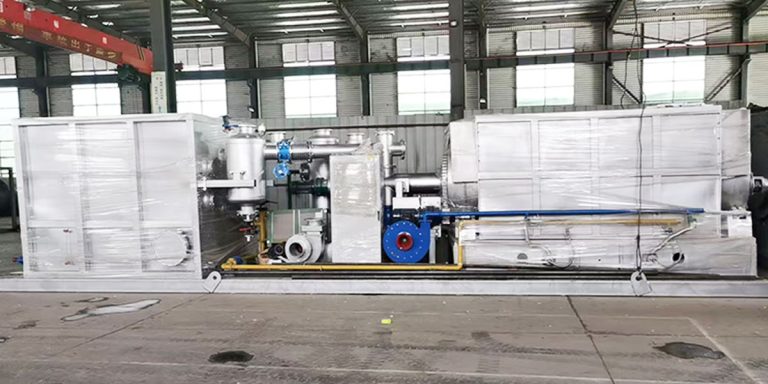
Skid-mounted design: The pyrolysis reactor, feeding system, condensation separation, tail gas treatment, and control system are integrated in a standard container.
Compact and flexible: The small pyrolysis machine has a small footprint and is suitable for small-scale pyrolysis. It can process 1-2T/D waste tires.
Quick installation: After the small pyrolysis machine is transported to the site, it only needs simple installation and commissioning.
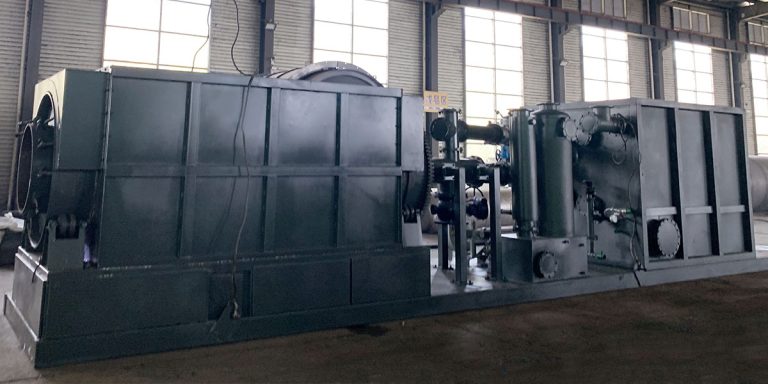
Batch tyre pyrolysis equipment mainly uses whole waste tires as raw materials. The tires do not need to be pre-processed such as cleaning, crushing, wire drawing, etc. They are automatically fed into the pyrolysis reactor directly under the action of the hydraulic loader. The feeding process is highly automated, safe and convenient.
Batch pyrolysis plant has a low investment threshold and a daily processing capacity of 2-15 tons. It is suitable for small-scale tire pyrolysis recycling or as an exploratory project in the early stages of the industry.
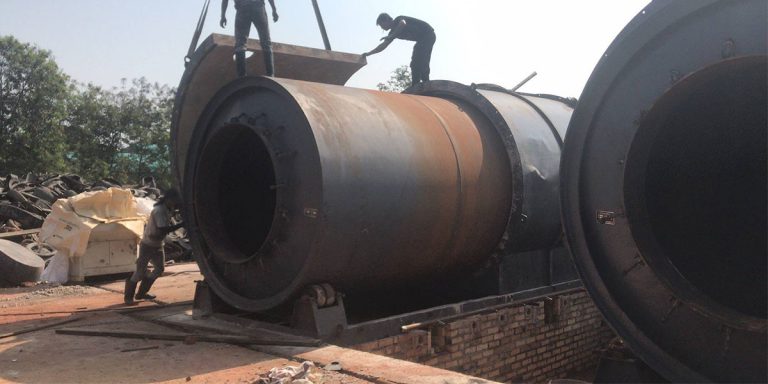
Semi-continuous pyrolysis plant represents a highly efficient compromise between batch and fully continuous pyrolysis systems. It combines four core advantages: continuous production capacity, low investment, ease of operation, and stable environmental performance.
Compared to batch pyrolysis plant, the biggest advantage of semi-continuous tyre pyrolysis plant is that it eliminates the need for manual start-up and feeding. It can achieve high-temperature slag discharge, thereby significantly improving production efficiency.
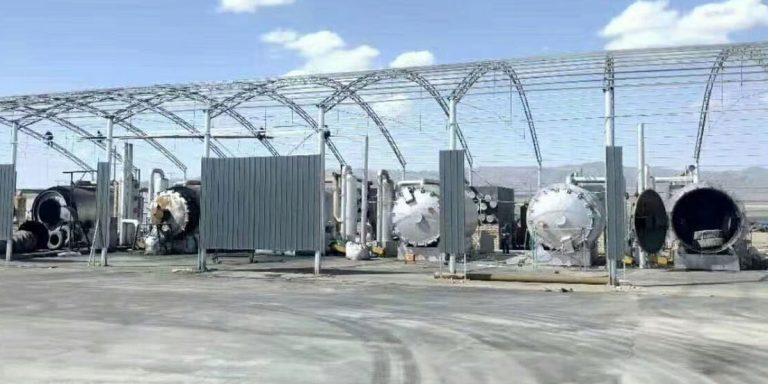
The fully automatic tyre pyrolysis plant adopts continuous feeding, pyrolysis, and slag discharge. The entire wsate tyre process is intelligently controlled by PLC, ensuring continuous and stable operation 24 hours a day. Its modular design allows for short installation and commissioning cycles and adaptability to various site conditions.
Continuous pyrolysis plant focuses on solving industry challenges such as system coking, dynamic sealing, and product polymerization. It is suitable for large-scale, industrialized continuous production.
Tyre Pyrolysis Plant Technical Specifications
Model
Capacity
Reactor Size
Operation
MJ-2
2T/D
D1400*L4000mm
Skid Mounted Batch Type
MJ-6
6T/D
D2200*L6000mm
Batch Type
MJ-10
10T/D
D2600*L6600mm
Batch Type
MJ-12
12T/D
D2800*L7100mm
Batch Type
MJ-15
15T/D
D2800*L8000mm
Batch Type
MJL-15
15-16T/D
D2800*L7100mm
Semi-continuous Type
MLL-20P
25-30T/D
D1600*L26000mm
Fully continuous Type
MLL-30T
35-40T/D
D1600*L26000mm
Fully continuous Type
Applicable fuel
Coal/natural gas/LPG/ Diesel/wood/pyrolysis oil
Thickness of Reactor
16mm/18mm
Cooling method
Water Cooling
Land Required
300-400m2
Operating Pressure
Constant pressure
If you’re interested in purchasing or learning more about tyre pyrolysis equipments, you can contact Mingjie Pyrolysis Plant Manufacturer. Let me know if you need help finding specific models!
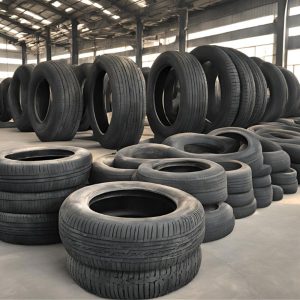
Old tyres are a common solid waste, which mainly consists of rubber and steel wire. It takes more than a hundred years for waste tires to be decomposed by microorganisms. It is worth noting that the quality of truck tires is very different from other tires, so truck tires are more difficult to handle.
Burning tires will produce smoke, oil and other toxic substances. Considering stricter environmental regulations, energy crisis, fuel consumption, pyrolysis is a more suitable treatment method for waste tires. The waste tyre pyrolysis plant converts waste tires into high-value products, including fuel oil, carbon black and steel wire.
Waste Tyre Pyrolysis To Fuel Oil
The tyre recycling pyrolysis system is currently the most widely used waste tire oil refining method. Pyrolysis technology decomposes waste tires under high temperature and oxygen-free conditions. It converts organic matter in tires into gas, liquid and solid products.
The tyre pyrolysis plant processes waste tires to produce four products: fuel oil, carbon black, steel wire and oil and gas. The fuel oil can be further processed into gasoline, diesel and asphalt if further processed. Our pyrolysis oil distillation plant can further refine the pyrolysis oil.
Tyre Recycling Pyrolysis Process
Feeding
First, open the feeding door and put the tire into the reactor manually or by feeding machine. After feeding, close the feeding door.
Pyrolysis
Then, heating the reactor by the burner. The fuel can be LPG, natural gas, or the pyrolysis oil produced by the equipment. When the temperature inside of reactor reach to 120 degrees, there will be mixed oil gas generation that will come to the manifold.
In the manifold, the heavy oil gas will be liquefied and become the heavy oil, which will flow to the heavy oil tank. The light oil gas will keep on rising up and enter the oil gas condenser.
In the oil gas condenser, the light oil gas will be liquefied to pyrolysis oil and flow to the oil storage tank. Un-condensable syngas will come out from the oil storage tank and enter the hydroseal. In the hydroseal, the un-condensable syngas will be cleaned and desulfurized and then recycled as fuel for heating the reactor. The extra syngas will be burned out in the extra syngas burning room for releasing the reactor’s pressure in case the pressure is too high.
Cooling
After the pyrolysis process finished, the reactor needs to be cooled for 4-6 hours. Until the temperature of the reactor is reduced to about 50 degrees, the discharger can be opened, and the carbon black will enter the first carbon black screw discharger, and fall into the secondary water cooling discharger.
During the transport process, due to the water cooling system, the temperature of the carbon black will be reduced. Then the carbon black will be stored in bags, sealed off from air.
After getting out the carbon black, the steel wire will remain in the reactor, open the furnace door to pull out the steel wire. Then load the tire for next batch.
Flue Gas Purification
During the pyrolysis process, due to the combustion of fuel, there will be high temperature smoke generation. High temperature smoke will be first led to the flue condenser by the draft fan, to cool down the temperature of the flue gas. After that go to the dedusting scrubber for cleaning by water washing, ceramic ring adsorption and water spray, then the emission can be discharged into the air through the chimney.
CONTACT US
Please Feel free to give your inquiry in the form below, and we will reply you in 24 hours.