
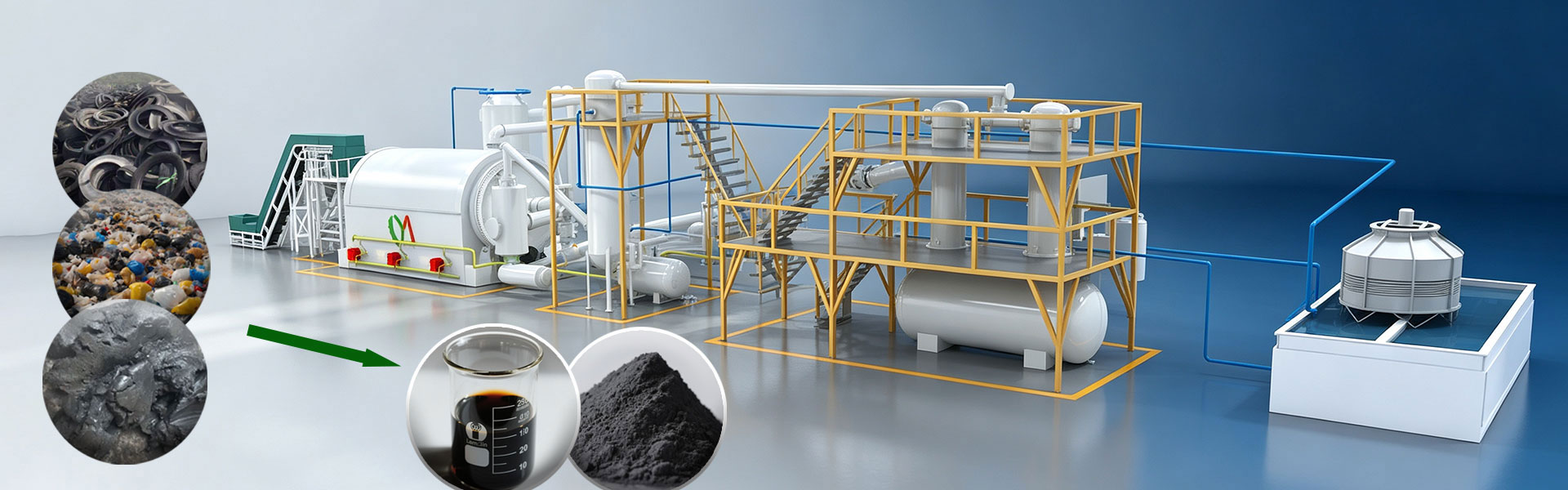
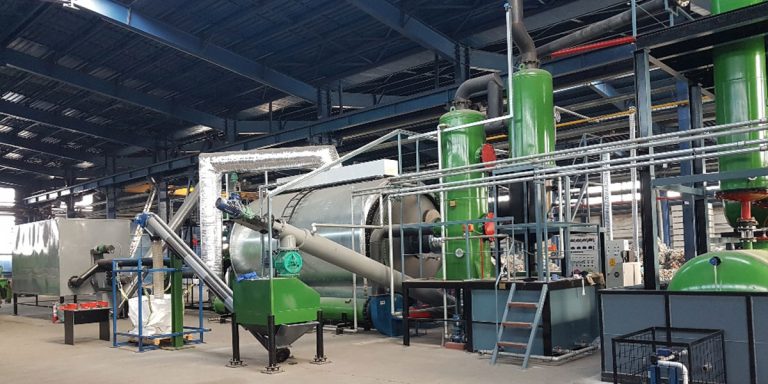
The semi continuous pyrolysis plant is an ideal choice for small and medium-sized recycling companies, efficiently converting waste tires and plastics into fuel oil and carbon black. It primarily processes pre-treated granular or powdered materials. It is not suitable for direct feeding of uncrushed whole tires.
Semi Continuous Pyrolysis Plant for Sale
Semi continuous pyrolysis is a process that falls between batch pyrolysis and continuous pyrolysis. It combines the advantages of low investment in batch pyrolysis plant and high production efficiency in fully continuous pyrolysis plant. For most medium to large-scale commercial solid waste recycling projects, semi continuous pyrolysis plant is a solution that balances economic and environmental benefits.
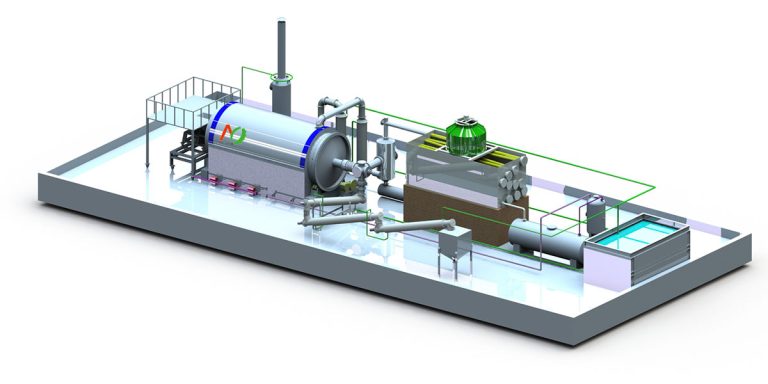
- Feeding size shall be 5-8mm rubber granule, tyre shall be shredded and steel wire will be removed.
- Processing capacity 15-16T/D tyre, 12T/D plastic.
- Equipped with auto feeder system, feeding can be done at high temperature.
- From feeding to discharging, the whole press is sealed, operation environment is clean.
| Model | Capacity | Reactor Size | Operation |
| MJL-15 | 15-16T/D | D2800*L7100mm | Semi-continuous Type |
| Applicable fuel | Coal/natural gas/LPG/ Diesel/wood/pyrolysis oil | ||
| Thickness of Reactor | 16mm/18mm | ||
| Cooling method | Water Cooling | ||
| Land Required | 300-400m2 | ||
| Operating Pressure | Constant pressure | ||
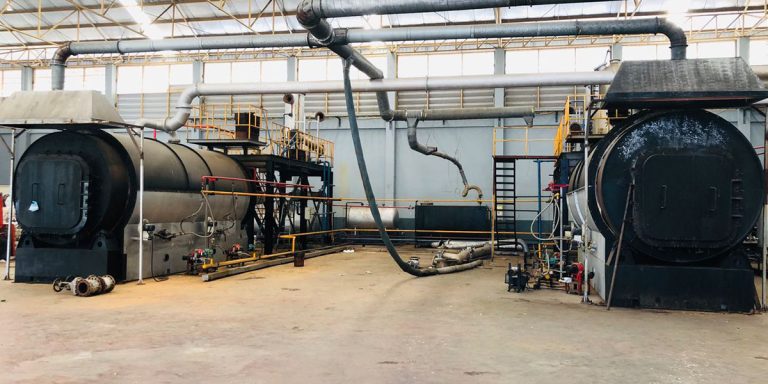
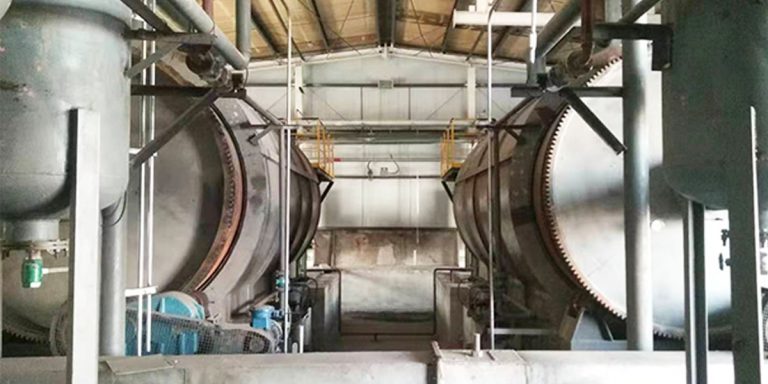
If you’re interested in purchasing or learning more about pyrolysis equipments, you can contact Mingjie Pyrolysis Plant Manufacturer. Let me know if you need help finding specific models!
Operating Mode of Semi Continuous Pyrolysis Plant
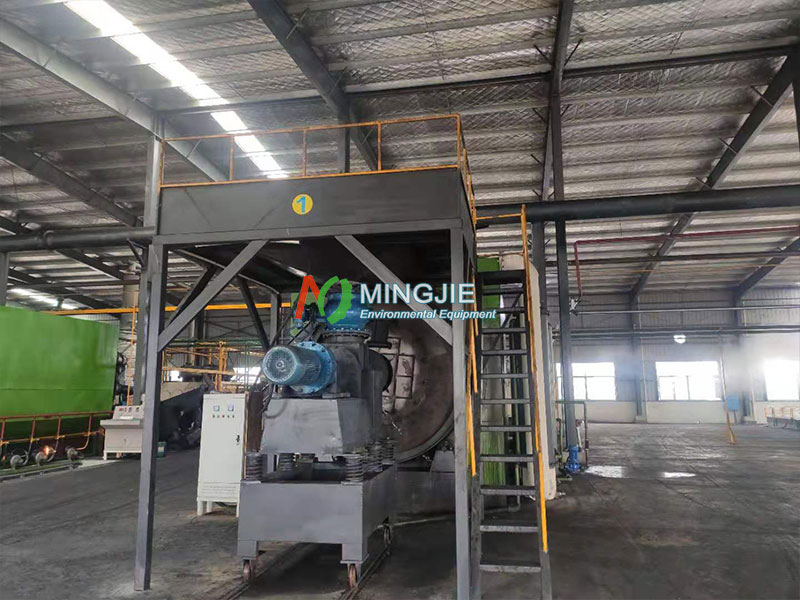
- Continuous Feeding, Batch Discharge: The feeding system uses a spiral sealed feeder for automatic feeding. Discharge requires the reactor to complete pyrolysis and then stop heating. After discharge, the next batch is fed, and the cycle repeats.
- No Complete Cooling Required: Semi continuous pyrolysis plant can discharge slag at high temperatures without waiting for the reactor to completely cool. This significantly reduces downtime for pyrolysis equipment and improves overall production efficiency.
- Moderate Automation: Compared to batch pyrolysis system, semi continuous pyrolysis plant offers a higher degree of automation, reducing the labor intensity of feeding and slag discharge. It improves the production environment and better controls dust and exhaust gas leaks.
Semi Continuous Pyrolysis Process
The core feature of the semi continuous pyrolysis plant is continuous feeding and batch slag discharge. It balances production efficiency with operational flexibility.
- Pretreatment: Raw materials (waste tires, plastics, oil sludge) need to undergo pretreatment such as crushing and screening. This ensures uniform particle size, facilitating subsequent pyrolysis reactions. Some raw materials may also require the removal of metallic impurities.
- Continuous Feeding: Pretreated materials are continuously fed into the pyrolysis furnace through a sealed feeding system. The feeding process remains sealed to prevent air ingress, ensuring an oxygen-free or oxygen-deficient pyrolysis environment.
- Pyrolysis Reaction: The material decomposes under heat in the pyrolysis furnace, with the temperature typically controlled between 300-900℃. The specific temperature depends on the raw materials and process requirements. During pyrolysis, organic matter undergoes a cracking reaction, generating pyrolysis oil, syngas, and carbon black products.
- Pyrolysis Products Separation and Collection: The oil and gas produced by pyrolysis are cooled by a condensation system and separated into liquid pyrolysis oil and syngas. Pyrolysis oil can be used directly as fuel or further refined into non-standard diesel oil through a distillation plant. Syngas, after purification, is partially reused as fuel for the pyrolysis furnace, with the remainder meeting emission standards.
- Batch Slag Discharge: After pyrolysis, the pyrolysis furnace stops heating. Solid residue is batch discharged via a screw conveyor. After cooling and separation, it is used as carbon black or further processed. The slag discharge process can be carried out at high temperatures, without waiting for the furnace to completely cool down.
- Flue Gas Treatment: The flue gas is treated by dust removal, desulfurization, and denitrification before being discharged in compliance with emission standards.
CONTACT US
Please Feel free to give your inquiry in the form below, and we will reply you in 24 hours.