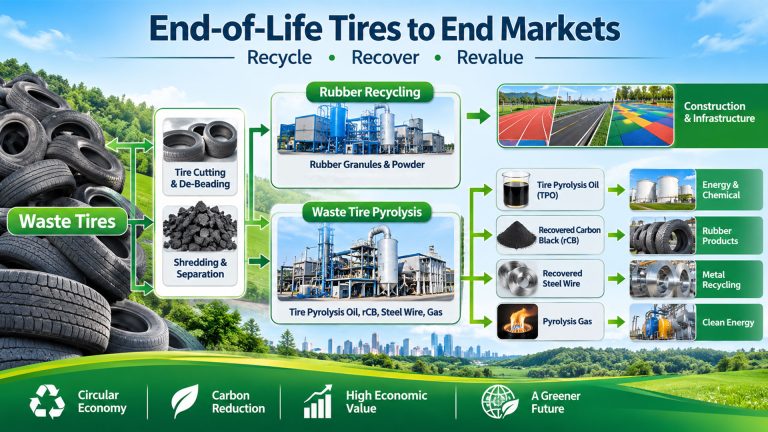
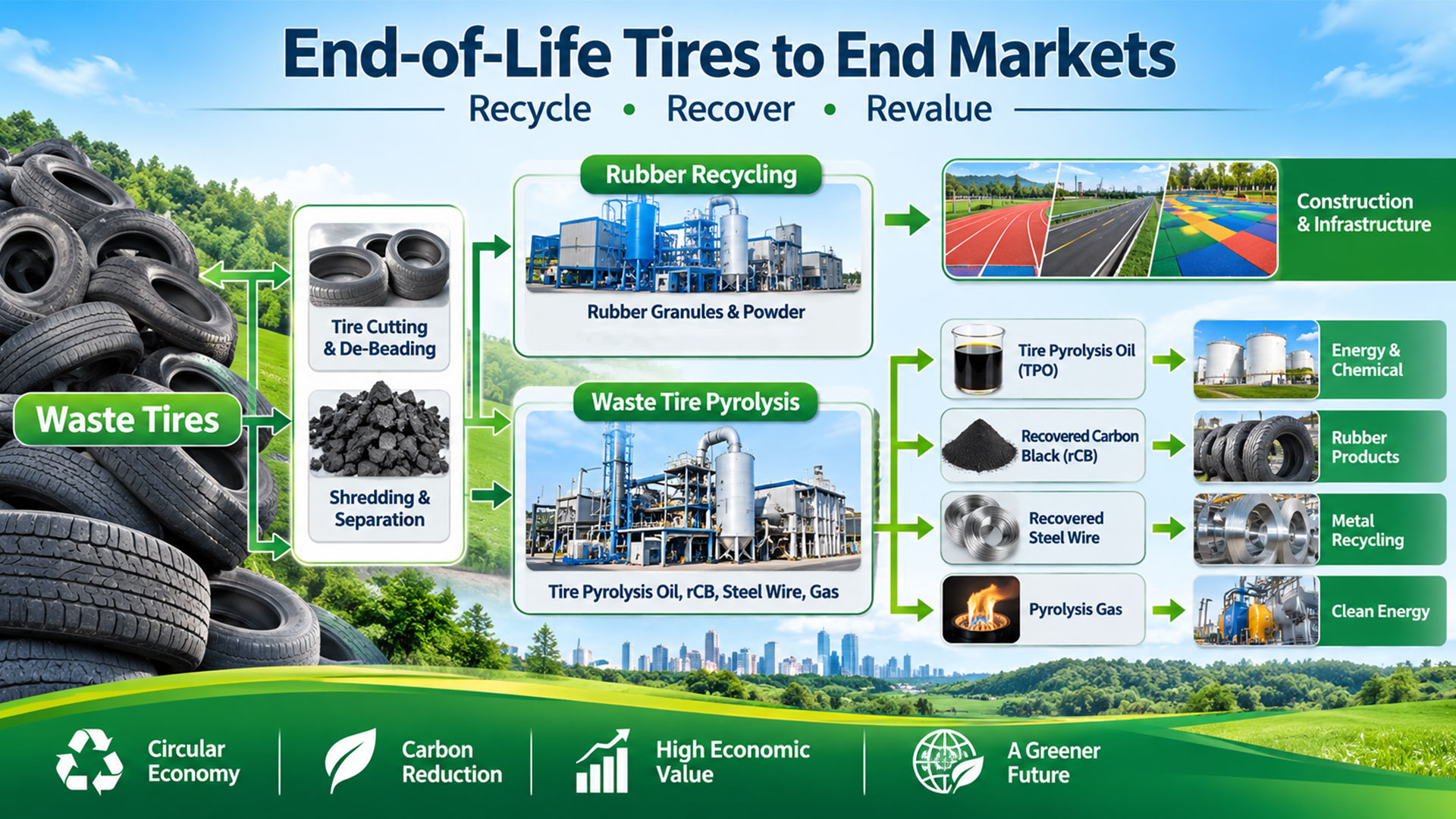
Globally, more than one billion tires reach the end of their service life every year. The management of these end-of-life tires (ELTs) is shifting from simple waste disposal toward a structured, circular supply chain. The end markets for end of life tire recycling are increasingly focused on high-value applications, including road construction, modified asphalt, rubber products, and pyrolysis outputs.
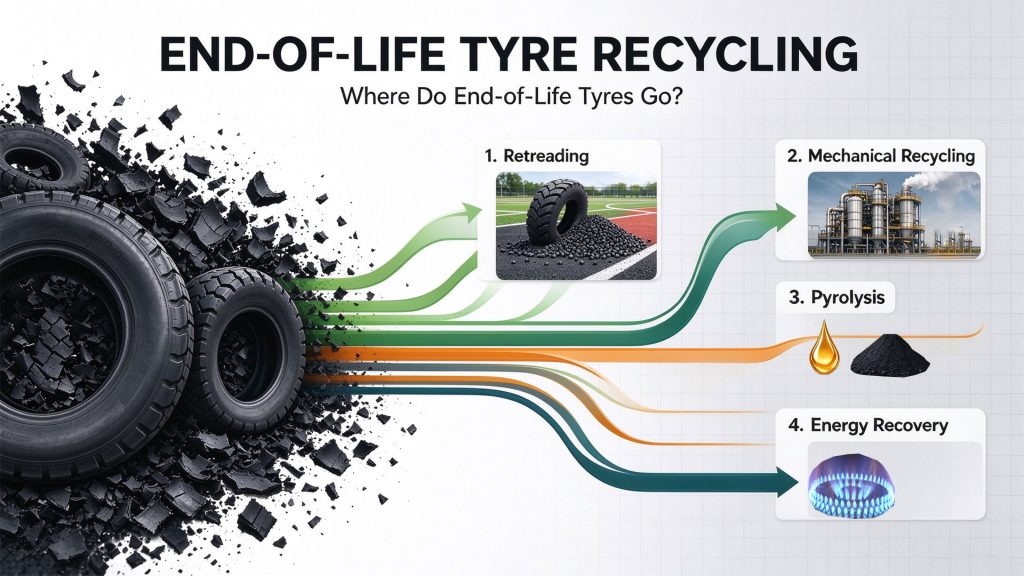
These end-market pathways follow a sustainability hierarchy: tire retreading, mechanical material recycling, high-value pyrolysis, and energy recovery. Each approach offers a distinct economic value, collectively shaping the global landscape of the ELT recycling industry.
Circle End of Life Tyres Retreading
Among the various ways for end of life tire recycling, retreading ranks at the top. It extends the service life of a tire casing without compromising its rubber matrix. This sector primarily covers tires for trucks, buses, heavy machinery, and aircraft, as their casings often retain sufficient structural integrity even after the tread has worn down.
During the end of life tire recycling retreading process, eligible casings undergo inspection and buffing before a new tread compound is applied. They are then vulcanized, enabling a new cycle of use. Among all ELT management methods, retreading has the lowest embodied carbon emissions and significantly reduces the demand for virgin rubber and steel. If a tire fails the initial screening for retreading, it is directed toward downstream processes, such as granulation or pyrolysis.
Mechanical End of Life Tire Recycling
In end of life tire recycling process, most ELTs that cannot be retreaded are processed through mechanical shredding. This separates the tires into three core components: rubber granules or powder, steel wire, and textile fibers.
The recovered steel wire is sent to steel mills to be reused as scrap metal. Textile fibers are currently mostly used for energy recovery or as low-grade filler material. The size of the rubber granules directly determines their downstream applications.
Coarse rubber granules (Tire Derived Aggregate TDA) are widely used in civil engineering projects. Examples include lightweight embankment fill, drainage layers, soil erosion control, backfill for retaining walls, and vibration-dampening layers beneath railway tracks. Its high permeability and low density make it an ideal alternative to stone aggregates in infrastructure projects.
Medium-sized rubber granules (1–20 mm) are primarily used in sports and leisure applications, such as infill for artificial turf, safety surfacing for playgrounds, running tracks, and equestrian arenas. This has long been a stable and high-demand outlet for recycled rubber.
Fine rubber powder (less than 2 mm) can be incorporated into rubberized asphalt for use on highways and urban roads. Furthermore, this fine powder is used in the production of reclaimed rubber, rubber mats, hoses, gaskets, and various molded rubber products.
High-Value Pyrolysis Chemical Recycling
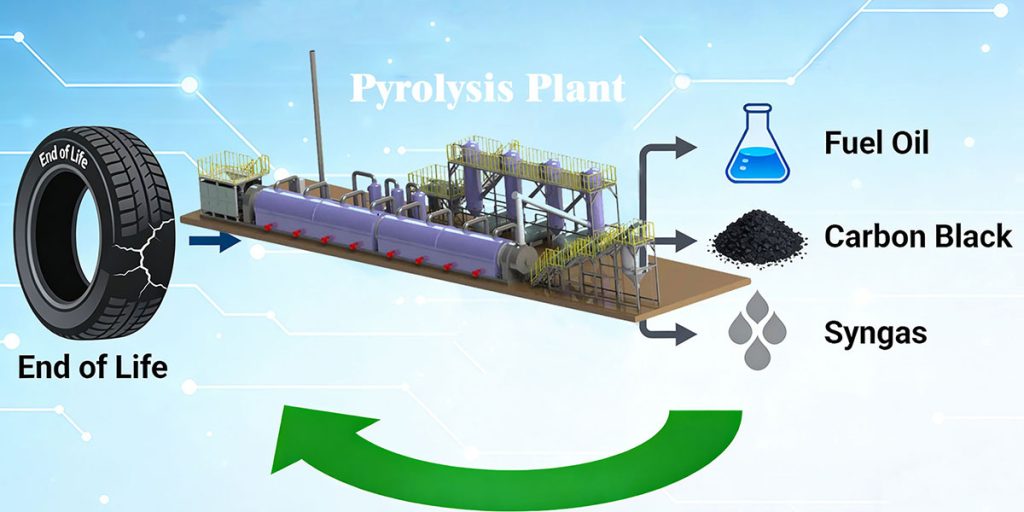
Tyre Pyrolysis represents the most dynamic emerging end-market for end of life tire recycling. Through thermal decomposition at high temperatures (400–700°C) in an oxygen-free environment, waste tires are converted into four commercially valuable products: pyrolysis oil, carbon black, syngas, and steel wire.
Pyrolysis oil can be used directly as an industrial fuel or refined further into transportation fuels or petrochemical feedstocks. Through further processing, pyrolytic carbon black becomes a highly commercially attractive product. Recovered carbon black can partially replace virgin carbon black in the production of new tires, thereby enabling a “Tire-to-Tire” circular model. Pyrolysis syngas is typically recycled to provide heat for the pyrolysis reactor, enhancing the facility’s energy self-sufficiency.
Driven by carbon reduction targets, ISCC standards, and various sustainability certification frameworks, pyrolysis capacity is expanding rapidly across Europe, Asia, and North America. Its primary role is to divert end-of-life tires (ELTs) away from low-value energy recovery pathways.
Tire-Derived Fuel (TDF)
Tire-Derived Fuel (TDF) has historically been one of the primary outlets for end of life tire recycling. Once shredded, these waste tires—which possess a high calorific value—are frequently used for co-processing in cement kilns, power boilers, and paper mills. In cement production, the energy contained in the rubber can serve as a substitute for coal. While the steel and ash components are incorporated into the mineral matrix of the cement clinker, eliminating the need for separate ash disposal.
While TDF provides a means to process large volumes of end-of-life tires, it ranks relatively low in the hierarchy of a circular economy. This is because the rubber material is entirely consumed in the end of life tire recycling process rather than being recovered or reused.
Transformation and Outlook of the End-of-Life Tire (ELT) Market
The end-market landscape for end-of-life tires (ELTs) is undergoing a significant structural shift. For decades, energy recovery and the use of low-grade rubber granules have been the dominant applications. Today, two key trends are reshaping the flow of these resources.
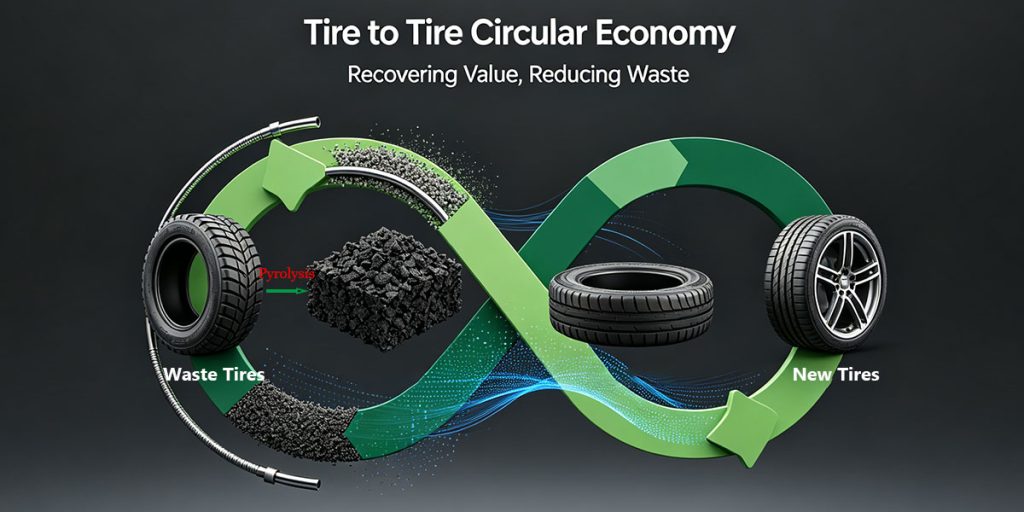
First, the demand for rubberized asphalt in road infrastructure projects is sustaining steady growth in mechanical recycling. Second, driven by corporate carbon-reduction targets and certification standards for circular materials, pyrolysis technology—along with the production of high-grade recovered carbon black (rCB)—is capturing an increasingly large market share.
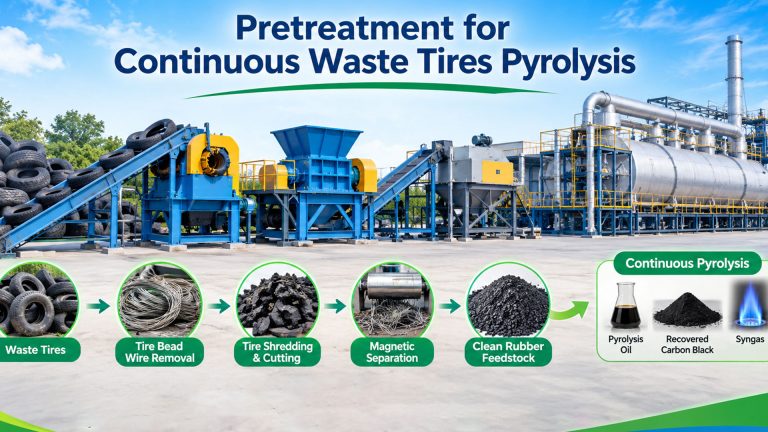
For operations in the ELT sector, the most compelling business model is as follows: Waste Tires → Pretreatment → Continuous Pyrolysis → TPO (Tire Pyrolysis Oil) + rCB + Steel Wire → Energy, Chemical, Rubber, and Steel Industries.
The end of life tire recycling is no longer merely a means of waste disposal. It has evolved into a circular economy value chain that transforms waste rubber into a diverse range of industrial raw materials.