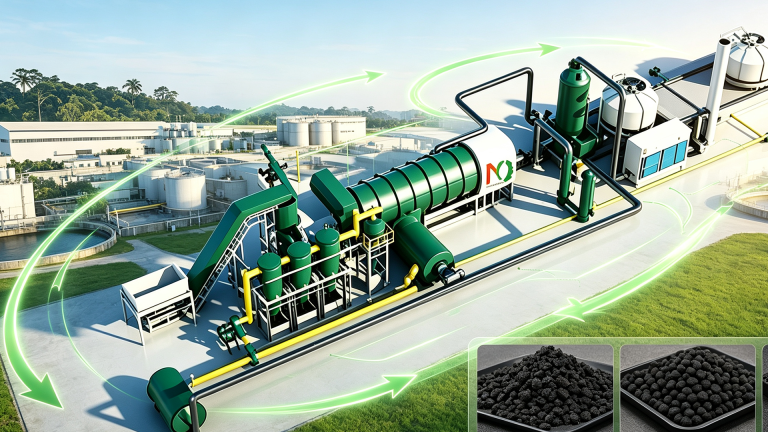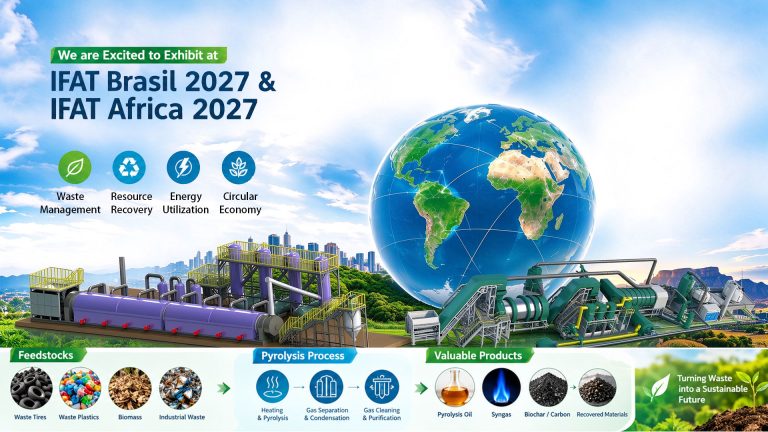
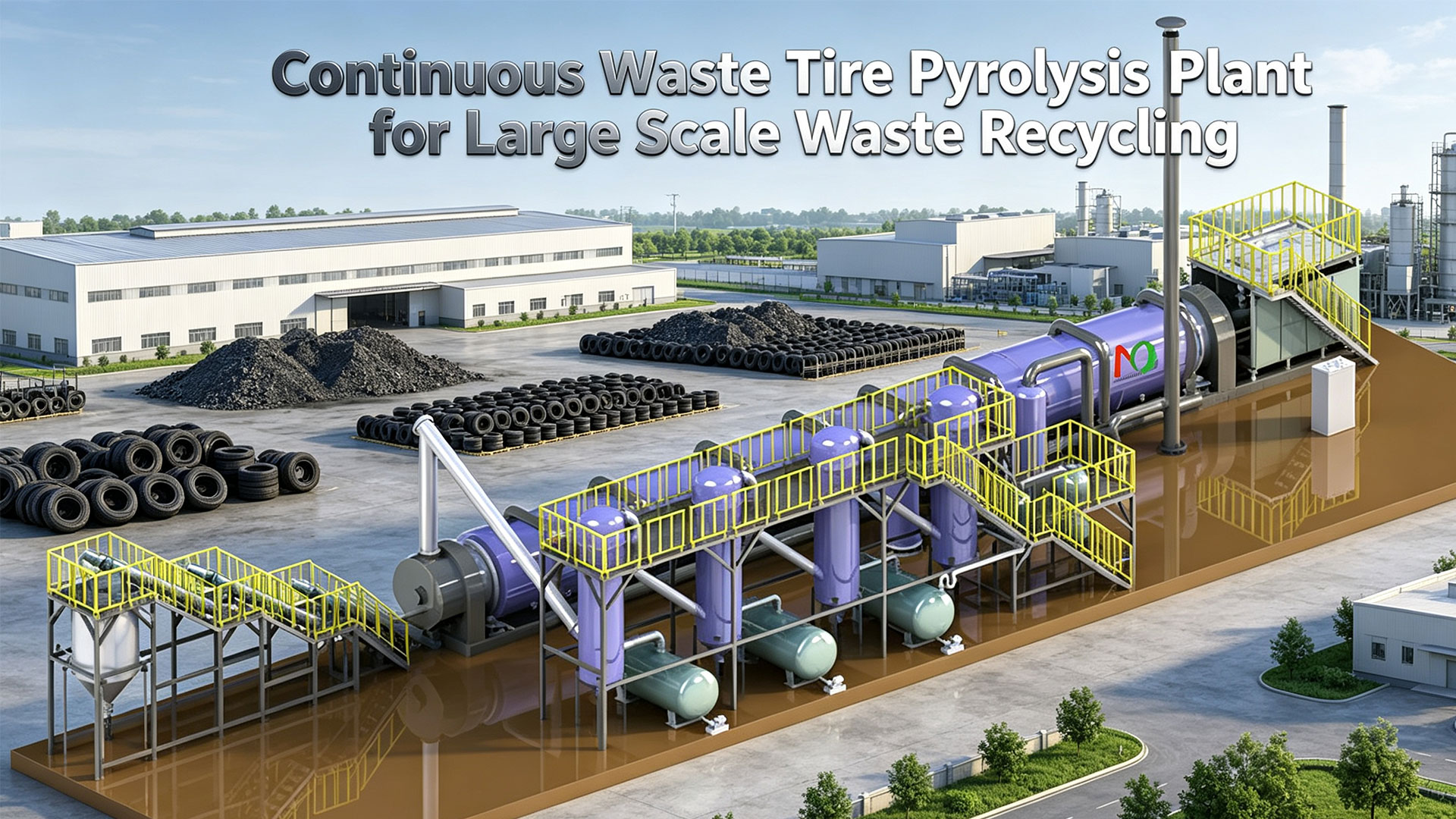
The global tire pyrolysis industry is gradually developing towards higher efficiency, environmental protection, and higher value. Continuous pyrolysis technology, with its closed-loop continuous feeding-pyrolysis-discharge process, is becoming the mainstream approach for large-scale tire recycling projects worldwide. The fully continuous waste tire pyrolysis plant is becoming the core equipment for the industrialized recycling of waste tires.
In recent years, leading global tire companies such as Michelin, Bridgestone, and Pirelli, in conjunction with chemical and energy giants and pyrolysis technology companies, have been investing heavily in commercial tire pyrolysis plants worldwide. The trend is profoundly reshaping the landscape of the continuous waste tire pyrolysis industry. From technology verification to commercialization, it is driving the entire tire pyrolysis industry towards large-scale, standardized, and collaborative development across the entire supply chain.
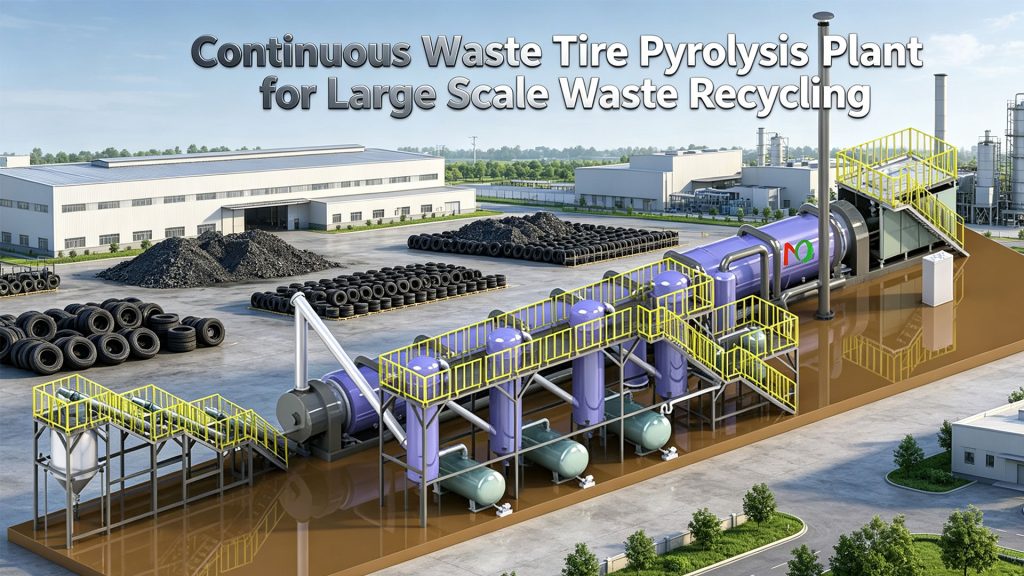
In the past, waste tire pyrolysis projects were mostly operated independently by small and medium-sized environmental protection companies. They faced bottlenecks such as long technology verification cycles, unstable product sales channels, and limited financial resources. Now, cross-industry alliances between tire manufacturers, chemical giants, and pyrolysis technology companies are breaking this pattern.
Tire to Tire Circular Economy Solution in Tire Pyrolysis Recycling Industry
Leading tire companies are deeply involved in the waste tire pyrolysis field. Their core objective is to reuse recycled carbon black (rCB) and tire pyrolysis oil (TPO) in new tire manufacturing, thereby completing a closed-loop Tire-to-Tire cycle.
In July 2026, Pirelli, in conjunction with pyrolysis technology company Pyrum, synthetic rubber producer Synthos, and chemical giant BASF, officially launched a “tire-to-tire” closed-loop circular economy project in Europe.
This waste tire pyrolysis project relies on an oxygen-free high-temperature pyrolysis process to decompose waste tires into recycled carbon black and pyrolysis oil, which are reused in tire production and chemical raw material production, respectively, ultimately producing synthetic rubber that re-enters Pirelli’s production lines.
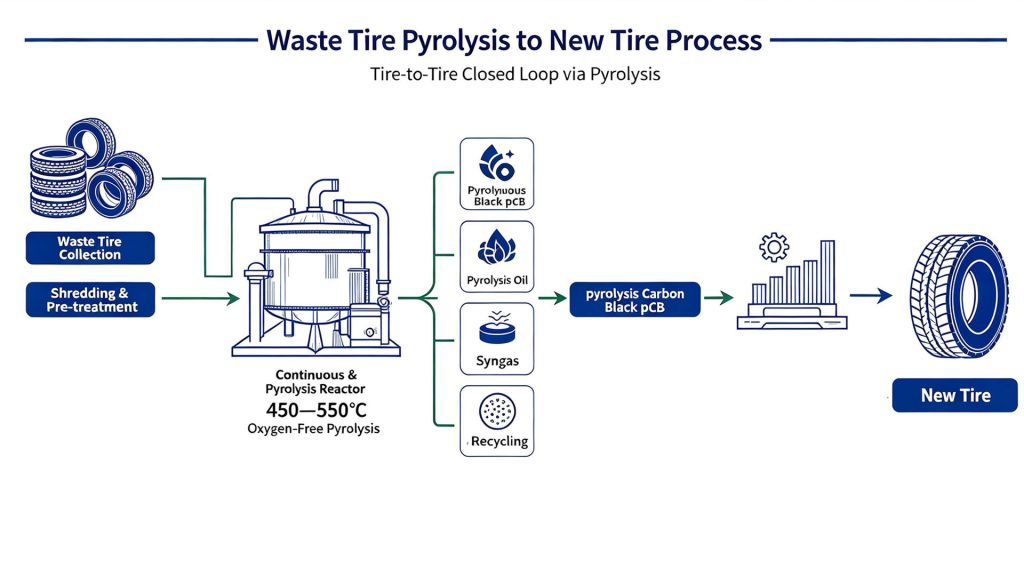
This is currently the most complete and well-established tire industry circular economy demonstration solution implemented globally. The entire waste tire recycling chain strictly adheres to the ISCC PLUS international sustainability certification system. It achieves full value chain traceability and control, ensuring the consistent quality of recycled materials.
Continuous Waste Tire Pyrolysis Plant: Core Capabilities Supporting Closed-Loop Implementation
The continuous waste tire pyrolysis plant solves the fundamental problems hindering the implementation of closed-loop solutions for tire pyrolysis recycling.
Stable Quality of Tire Pyrolysis Products
Closed-loop recycling requires recycled carbon black and pyrolysis oil to meet stringent industrial quality control standards, enabling their entry into high-end applications in tire manufacturing and chemical production. This is directly related to the characteristics of continuous waste tire pyrolysis equipment.
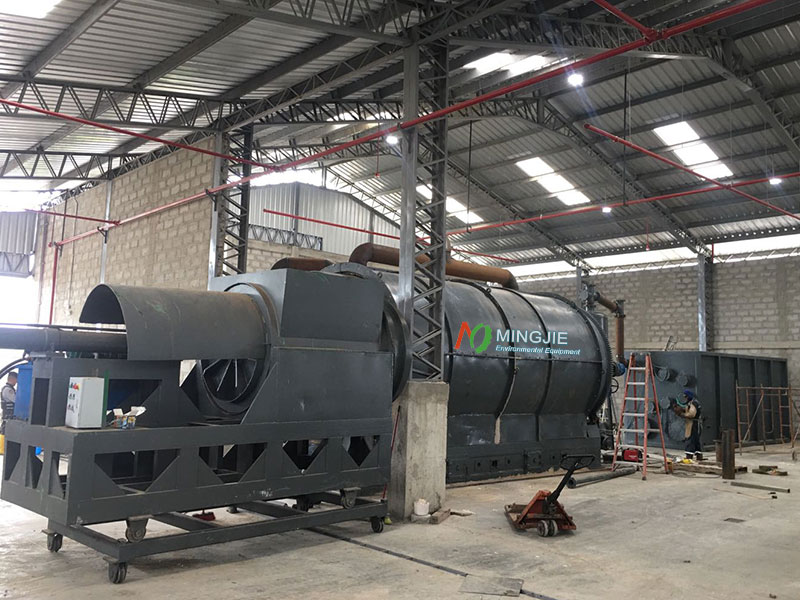
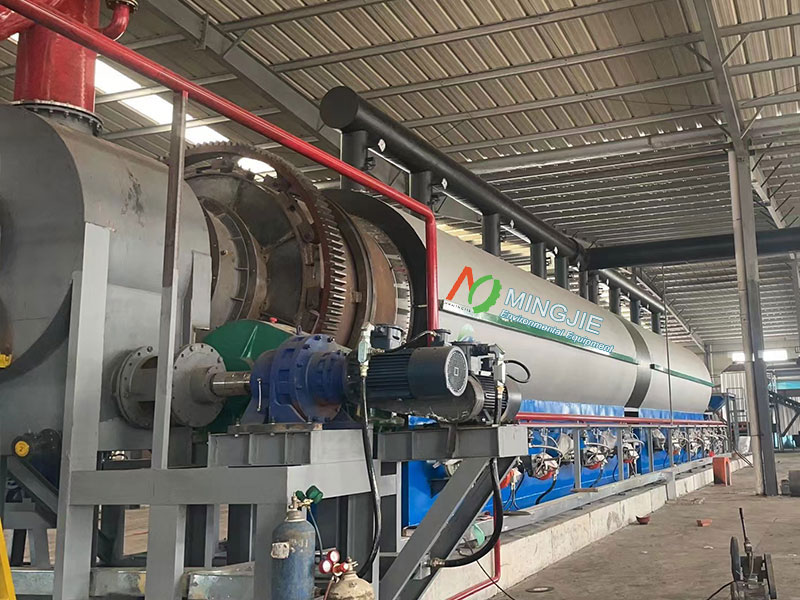
Batch pyrolysis equipment results in significant fluctuations in tire pyrolysis product quality, making standardized supply difficult. Continuous pyrolysis plant, through precise control of temperature, pressure, and residence time, achieves long-term stable operation, producing pyrolysis products of uniform quality.
Traceability of the Certification System
ISCC PLUS certification requires traceability across the entire value chain, from raw material sourcing to final products. The automated control system of continuous equipment can fully record the feed parameters, reaction conditions, and product data for each batch of raw materials. This provides essential data support for certification audits.
The closed-loop recycling solution in the tire industry creates clear market demand for continuous waste tire pyrolysis plant. Tire pyrolysis products are not only fuel but also an industrial raw material system. This significantly enhances the economic value of tire pyrolysis projects.
In Summary
Leading tire manufacturers are entering the pyrolysis industry, drawing waste tire pyrolysis from the solid waste-to-oil sector into a tire-chemical circular industrial system. This trend directly raises the technological threshold for continuous waste tire pyrolysis plants. Pyrolysis equipment is no longer simply about turning tires into oil and carbon black. It must stably produce recycled raw materials that can be reused in tire manufacturing.