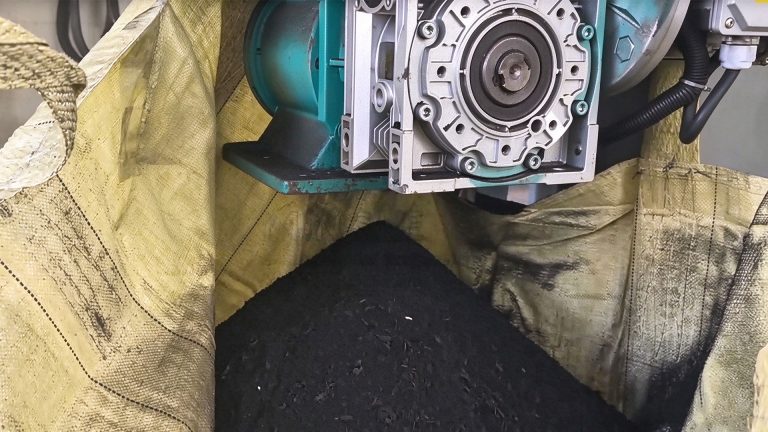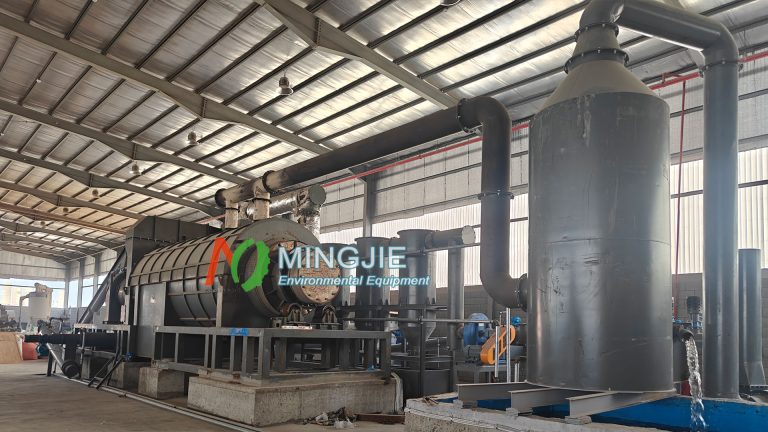
Pyrolysis is a key technology for obtaining biochar from rice straw. Mingjie Biomass Carbonization Plant produces high-quality biochar and syngas products through a continuous pyrolysis carbonization process.
Rice straw biochar is a carbon-rich aromatic compound produced by the pyrolysis of rice straw under anaerobic or limited oxygen conditions. It possesses high stability and excellent environmental benefits. Compared to untreated straw, straw biochar has significant advantages in chemical and biological properties, and is therefore considered a novel environmentally friendly material.
Rice straw, as one of the world’s largest agricultural residues, has long faced challenges in its disposal. Converting rice straw into biochar through pyrolysis technology is a sustainable approach to solving the pollution problem caused by straw burning. The production of straw biochar offers both environmental benefits and economic value.
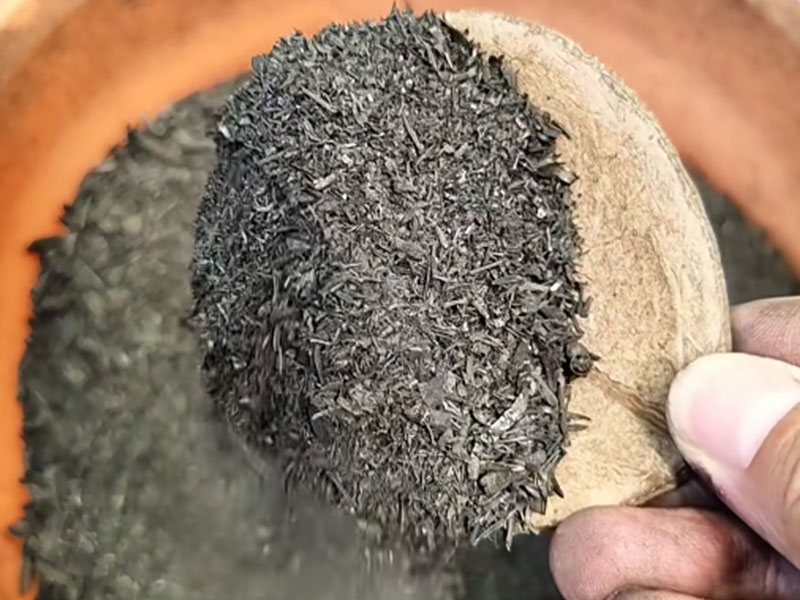
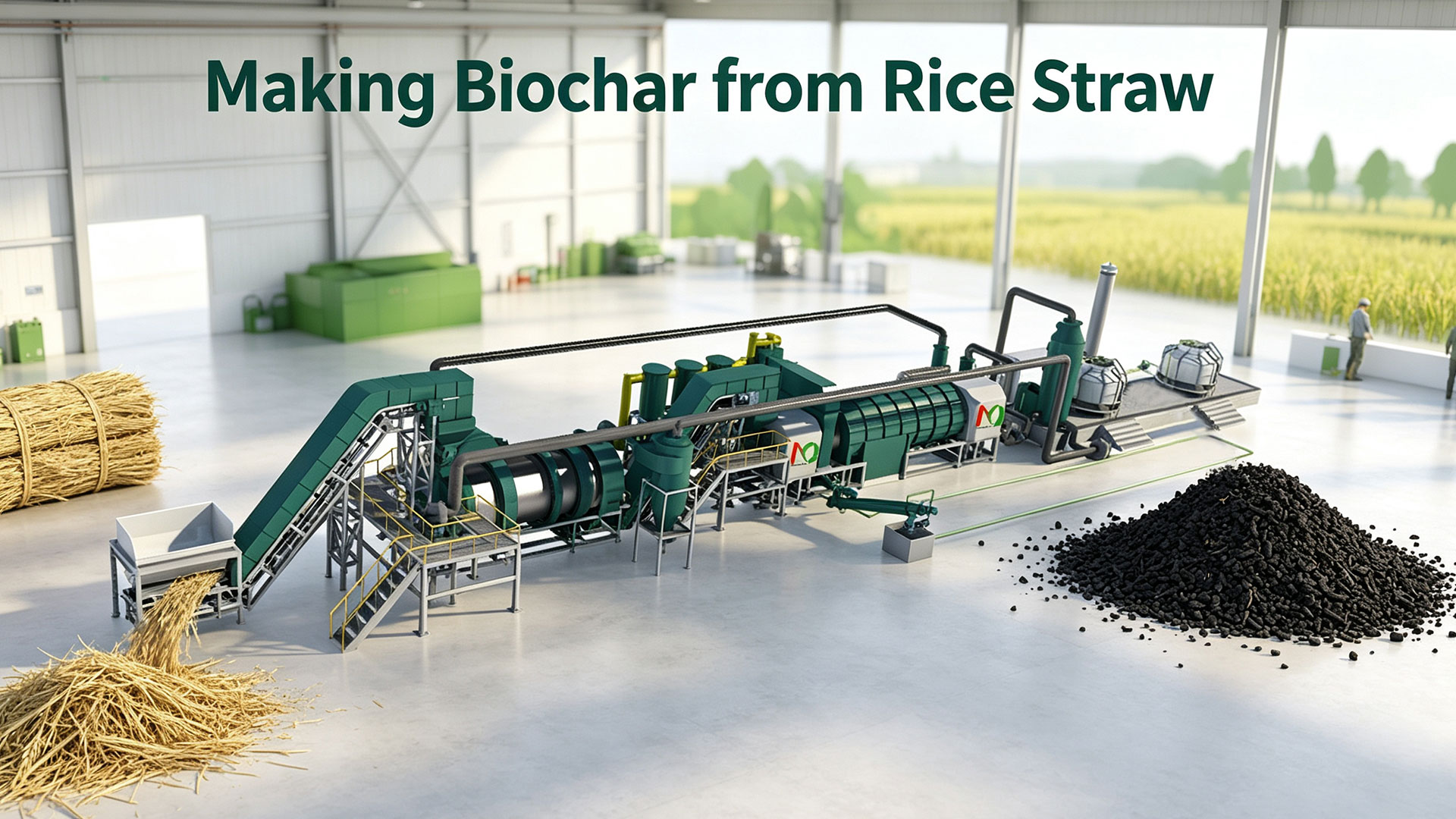
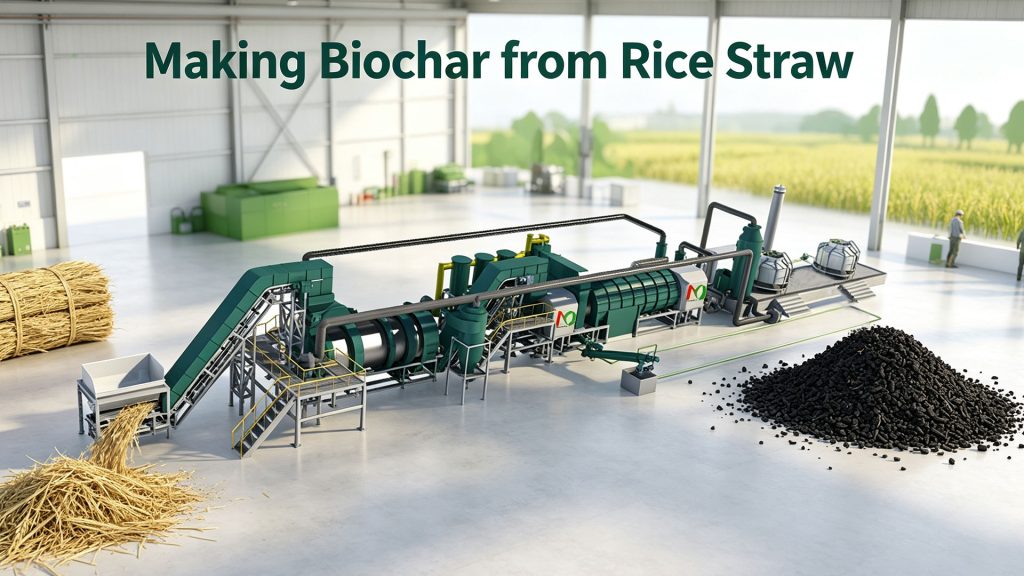
Making Best Biochar from Rice Straw by Slow Pyrolysis
Rice Straw Pretreatment and Feeding
The straw is pulverized using a pulverizer, with a length generally not exceeding 20mm. The pulverized straw is then dried in a drying system to reduce the moisture content to approximately 15%. This ensures a uniform and complete pyrolysis reaction in the subsequent process.
Slow Pyrolysis
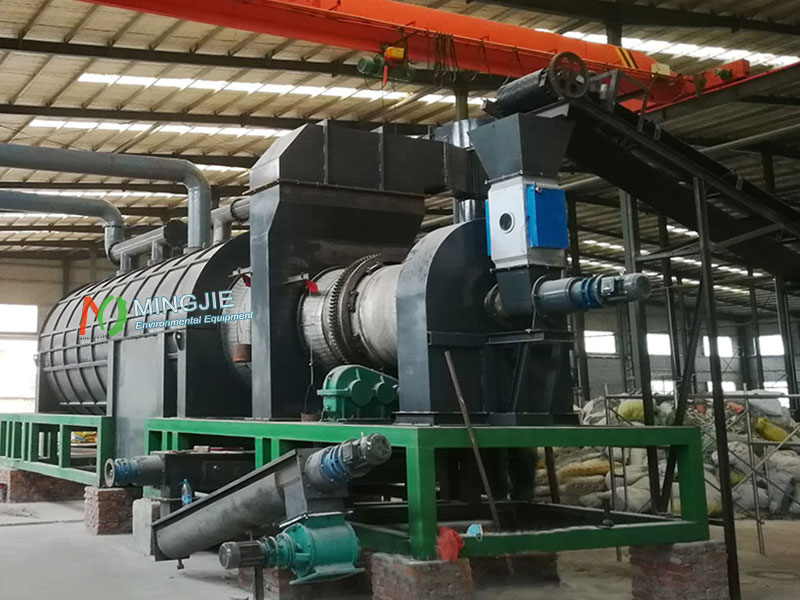
The pretreated straw is fed into a continuous biomass pyrolysis plant. Slow pyrolysis offers high biochar production yields and is better suited to the needs of industrialized agricultural production. Research indicates that 450-550℃ is the optimal temperature range for rice straw charcoal production. At this temperature, biochar yield is stable, specific surface area is large, and pore structure is most developed. Excessively high temperatures lead to biochar structure collapse and reduced yield. Insufficient temperatures result in incomplete carbonization and inadequate functionality.
Product Collection
The high-temperature biochar from rice straw must be cooled before discharging, so as to prevent spontaneous combustion caused by high-temperature contact with air. The syngas produced during straw pyrolysis is purified and can be used as fuel to heat the reactor, achieving energy recycling.
Which Countries are Suitable for Rice Straw Biochar Production Projects?
Rice straw biochar production projects are suitable for almost all countries that cultivate rice on a large scale, especially those that still widely use straw burning for disposal. However, the success of the project depends crucially on three conditions: local policy support, economic feasibility, and technological support.
These countries have stable and abundant supplies of rice straw: including China, India, Thailand, Vietnam, the Philippines, Indonesia, Pakistan, and some ASEAN countries.
The produced straw biochar needs a market. It can be used as a soil conditioner, a water treatment adsorbent, or to produce high-value fuels. Biochar requires clear demand to support the economic viability of the project.
Advantages of Large Scale Rice Straw Biochar Production
The core advantage of large scale rice straw biochar production lies in transforming environmental burden into economic benefits. It achieves synergistic effects on ecology, economy, and agricultural production.
Significant Environmental Advantages
This is the most core advantage of biochar from rice straw, especially when compared to direct straw return to the field.
Highly Efficient Greenhouse Gas Emission Reduction: Converting rice straw into biochar and then returning it to the field fundamentally changes the way greenhouse gas emissions are emitted during straw decomposition. Comparative studies have found that compared to traditional straw return, which significantly increases methane (CH₄) emissions from paddy fields, applying biochar significantly reduces greenhouse gas emission intensity. Under the same carbon input conditions, the global warming potential (GWP) of biochar return is only about one-fifth that of straw return.
A global study also shows that the rice straw biochar production scheme has the lowest global warming potential, reducing it by 2.46 to 3.22 times compared to open burning.
Long-term soil carbon sequestration: Biochar has extremely high stability and can remain undecomposed for over a century after being applied to the soil. This is equivalent to sealing the carbon from straw in a stable form within the soil, directly contributing to the goal of “carbon neutrality.” Some projects have calculated that applying 1 ton of biochar is equivalent to removing 1.5 tons of carbon dioxide.
Significant Agricultural Production and Economic Benefits
Large scale rice biochar production brings not only environmental benefits, but also economic returns.
Increased Yield and Quality, and Improved Soil: Experimental data shows that returning biochar to the field can significantly increase rice yield, with increases ranging from 12% to 17.2%. This effect is far superior to ordinary straw return. This is due to the unique porous structure of biochar, which increases soil organic matter content and improves soil structure.
Substantial Carbon Sequestration Revenue: This is a new profit growth point brought about by large scale biochar production. Through internationally recognized carbon credit certification platforms (such as Puro.earth), biochar projects can develop carbon sequestration into tradable carbon credits.
Economic Feasibility of the Business Model: From a whole-chain perspective, the net cash flow of the biochar solution is the highest among straw treatment methods. It not only generates revenue through the sale of biochar, but also obtains additional revenue by avoiding carbon credits gained from burning.