The waste plastic pyrolysis market is at a critical stage, transitioning from technology validation to large-scale commercialization. The global market size for plastics pyrolysis equipment was approximately US$781 million in 2025 and is projected to reach US$864 million in 2026.
The total designed capacity of plastics pyrolysis plants already in operation and under construction globally is rapidly expanding. By the end of 2026, the actual operating capacity of global plastics pyrolysis was approximately 4.76 million tons per year. However, constrained by raw material collection and the stability of pyrolysis equipment, the industry’s average load factor is only 52%.
The pyrolysis oil market is a core indicator directly reflecting the degree of commercialization of pyrolysis. In 2025, the global market size for waste plastics pyrolysis oil was approximately US$718 million. It is projected to grow to US$1.169 billion by 2034, with a CAGR of 5.56%. The pyrolysis oil directly corresponds to the end-product output of plastic pyrolysis plant. Its steady growth reflects the increasing market acceptance of pyrolysis oil as a fuel and chemical feedstock.
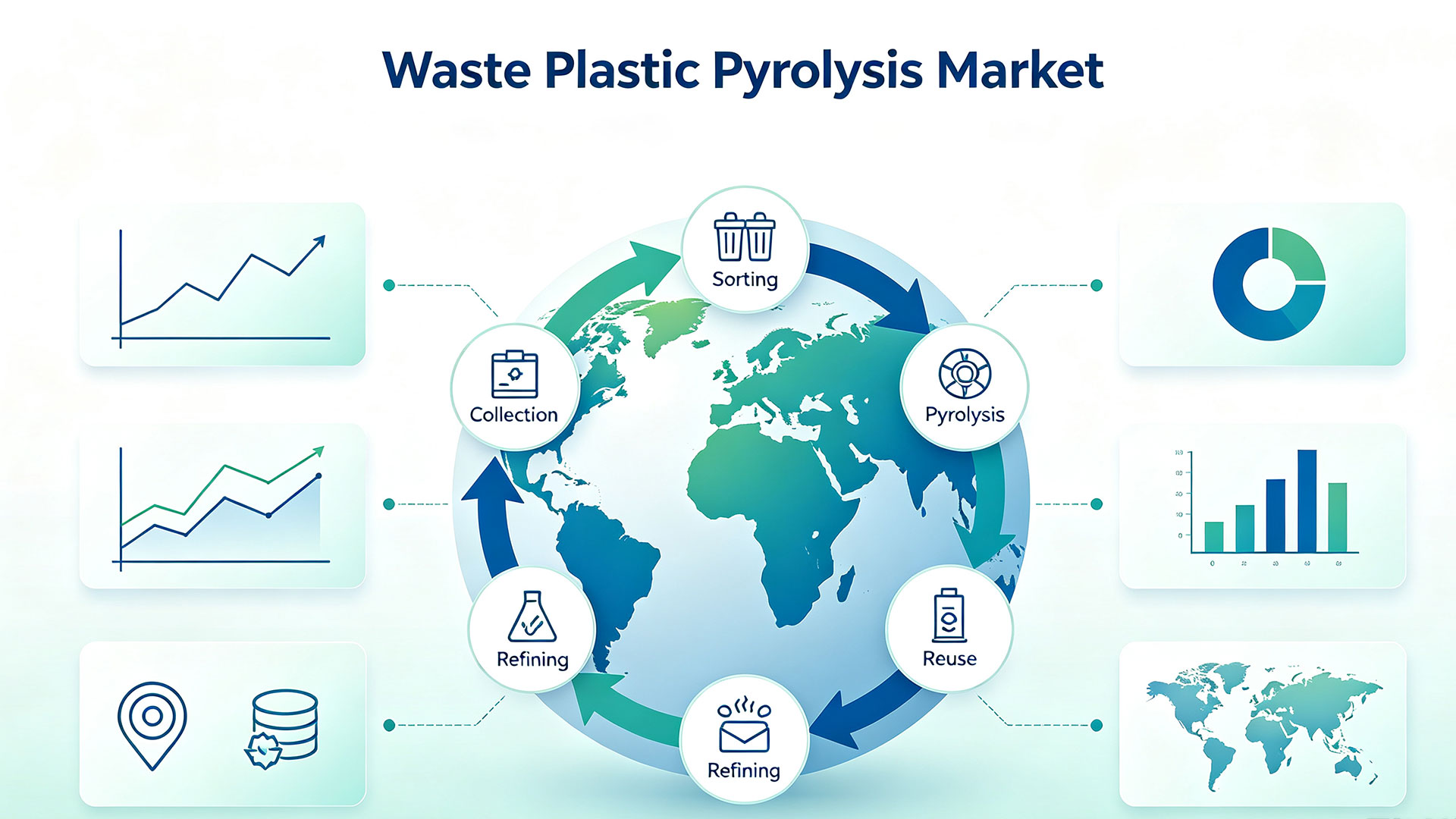
Complete Chain of Waste Plastic Pyrolysis Industrial
Upstream: Waste Plastic Raw Materials and Pre-treatment
Raw Material Sources: Waste plastics come from a wide range of sources, including food packaging, daily chemicals, and agricultural films. The main materials include PET, PE, PP, and PS. Effective sorting prevents interference between different plastics during pyrolysis and removes impurities such as metals and stones. This is crucial for the quality of the final pyrolysis products and the safety of the pyrolysis equipment.
Pre-treatment Processes: After sorting, waste plastics typically undergo crushing, washing, and drying processes. The aim is to reduce material size, improve pyrolysis efficiency, and remove contaminants that may produce corrosive substances or affect oil quality.
Midstream: The Core Pyrolysis Conversion Link
The pyrolysis plant is the technological core of the entire waste plastic pyrolysis industrial chain, where waste plastics undergo thermochemical reactions to convert into pyrolysis oil.
Batch pyrolysis plant holds a significant share of the waste plastic pyrolysis market due to its flexibility and relatively low investment threshold. However, continuous pyrolysis plants are becoming the fastest-growing segment. Their advantages lie in higher operational stability, greater automation, and suitability for large-scale plastic pyrolysis industrial applications.
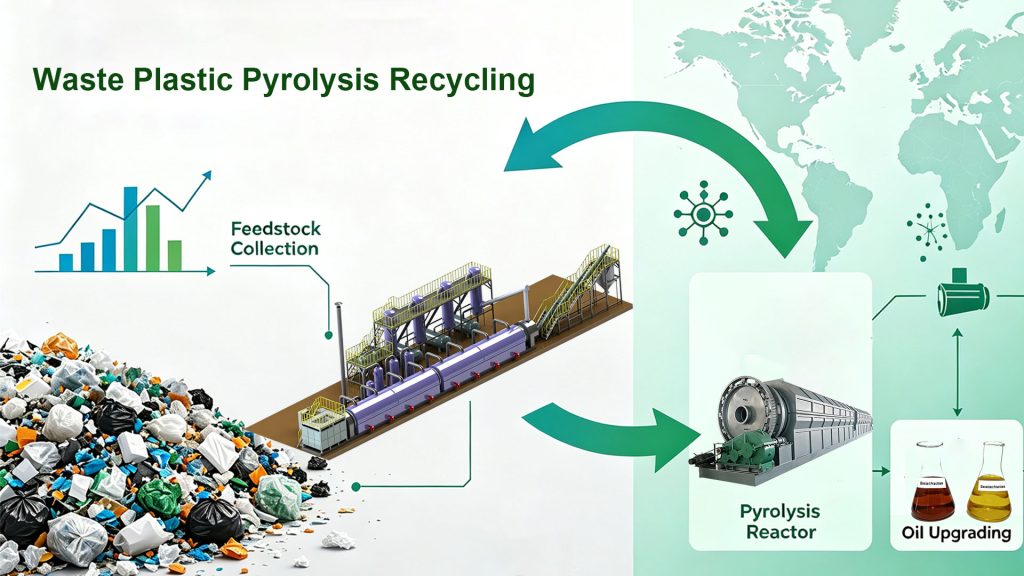
Downstream: Pyrolysis Products Application
The ultimate goal of the waste plastic chemical recycling industry chain is to truly transform pyrolysis products into marketable commodities, forming a closed loop of Plastic to Plastic.
High-Value Pyrolysis Oil: This is key to achieving the closed loop. After refining steps such as hydrogenation, pyrolysis oil can remove impurities and be upgraded to a raw material similar to naphtha. Subsequently, it can be used as a feedstock for steam cracking furnaces to produce basic chemical raw materials such as propylene and BTX (mixed aromatics). These raw materials are then polymerized to ultimately generate new plastics with properties indistinguishable from virgin plastics. This truly realizes the chemical cycle of “waste plastic to new plastic”.
Pyrolysis Carbon Black: After modification, pyrolysis carbon black can be used as a reinforcing agent in rubber products, activated carbon adsorbents, battery materials, and asphalt modifiers.
Syngas: In addition to being used for heating, syngas can also be further purified and used as clean fuel.
Regional Landscape of the Waste Plastic Pyrolysis Market
The regional landscape of the waste plastic pyrolysis market exhibits distinct characteristics. The Asia-Pacific region holds the largest market share (38-40%), primarily utilizing batch pyrolysis plant for waste plastic processing. Europe and the Americas dominate with large-scale continuous pyrolysis plants, placing greater emphasis on ISCC-PLUS sustainable feedstock certification. Pyrolysis oil ISCC Certificationl can command a 30-100% product premium, serving as a prerequisite for entering the high-end petrochemical supply chain.
Asia Pacific: Scale-Driven, Fastest Growing
Capacity expansion and policy support have propelled the Asia Pacific region to contribute over 48% of the global waste plastic pyrolysis market in 2026. China, the world’s largest producer and consumer of recycled plastics, has a recycling capacity exceeding 38 million tons per year. The regional self-sufficiency rate in India and Southeast Asian countries has increased from 62% in 2023 to 79% in 2025.
In terms of market share, the Asia Pacific region accounts for 31% of the waste plastic pyrolysis oil market, with China contributing 14%. However, it’s noteworthy that while the Asia Pacific region generates 46% of global waste plastics, its mechanical recycling rate is only 28%. This means a significant amount of plastic waste remains unrecycled, leaving substantial room for growth in the waste plastic pyrolysis market.
North America and Europe: Technology-Driven and Policy-Focused
The North American and EU markets have a significant advantage in pyrolysis technology penetration. Although their growth rate is slower than in the Asia-Pacific region, chemical recovery capacity already accounts for over 30%. In the pyrolysis oil market, Europe holds a 29% share, while North America holds 26%.
Policy is the core driver of expansion in the European and American markets. Another characteristic of these markets is their strong downstream integration capabilities. Advanced refining facilities provide readily available channels for upgrading and processing pyrolysis oil.